
The clearest signs your aging parent needs help are usually quiet ones: an unsteady walk to the kitchen, a stack of unopened mail, a refrigerator with more condiments than food, and a calendar that used to be full. Fall is when many of us make the drive or the flight to see a parent, and time away is exactly what makes gradual changes visible.
If you have been away since spring, you are in a better position to notice a change than someone who sees your mother every week. Decline rarely arrives as an event. It arrives as a series of small accommodations — a skipped shower, a handrail that became a necessity, a friend who stopped calling — and the people living inside those accommodations tend not to see them at all.
This is not about looking for problems. It is about walking in with your eyes open, so that if something has shifted, you find out now rather than after a hospital call in January.
Key Takeaways
- Look at four areas: steadiness on their feet, the state of the kitchen and the mail, personal care, and mood and social contact.
- More than 14 million adults age 65 and older — about one in four — report a fall each year, and fewer than half tell their doctor, according to the Centers for Disease Control and Prevention (CDC).
- About one in four adults 65 and older is socially isolated, which the National Institute on Aging links to higher rates of depression, heart disease and cognitive decline.
- Open-ended questions work better than warnings. Ask what has become harder, not whether they are “still able” to do something.
- Every Bay Area county has an Area Agency on Aging that will talk through options with you for free, before you commit to anything.
What to look for
The Changes That Are Easy to Miss
Institute on Aging, a San Francisco nonprofit that has served Bay Area older adults for decades, groups the warning signs into physical, household and behavioral categories. That framework holds up well, and it gives you something concrete to observe rather than a vague feeling that something is off.
How they move
Watch an ordinary trip across the room. Are they reaching for furniture, counters or walls to steady themselves? Do they avoid the stairs, or take them one foot at a time? Have they started sleeping in a downstairs room or a recliner?
Falls are the leading cause of injury for adults 65 and older, and the CDC reports that more than 14 million older adults — roughly one in four — fall each year. Just as important: fewer than half of them mention it to a doctor. Ask directly whether they have fallen since you last visited. Many parents will say no to “are you okay?” and yes to “have you had any slips or near misses lately?”
The kitchen, the mail and the household
Open the refrigerator. Expired food, very little food, or a freezer stocked entirely with single-serve meals tells you something about energy, appetite and the ability to shop and cook. Weight loss you notice by sight is worth raising with their doctor.
Then look at the surfaces. Unopened mail, stacked bills, past-due notices, or a house that is dustier and more cluttered than your mother would ever have allowed are all signals — sometimes about physical stamina, sometimes about memory or vision, sometimes about money.
Personal care
Changes in grooming — unwashed hair, the same clothes across several days, a beard that is no longer maintained, a noticeable odor — often mean that bathing has become difficult or frightening rather than unimportant. A slick tub with no grab bar is a genuine obstacle, not a preference.
Mood, memory and social contact
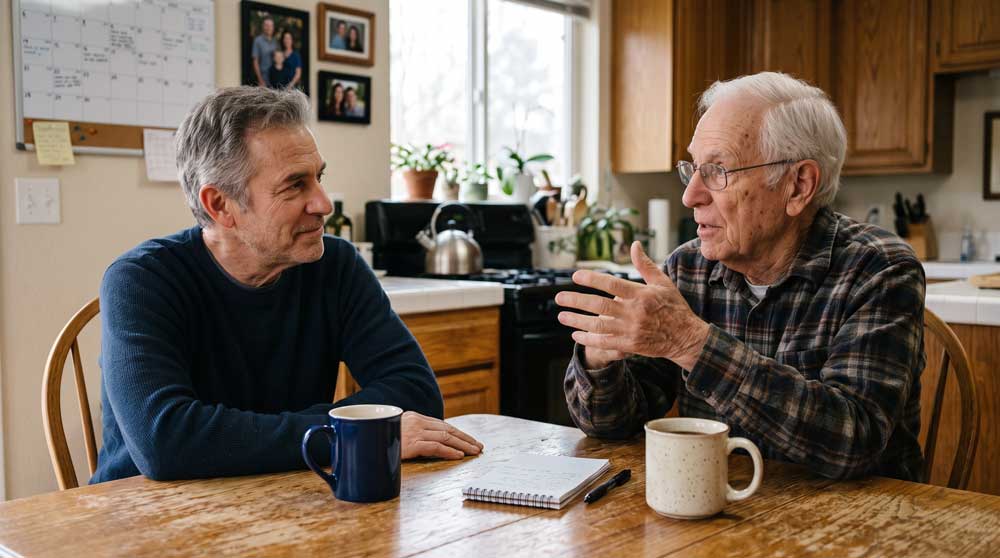
Ask who they have seen lately. Have they dropped out of the bridge group, the church committee, the walking club at the community center? Withdrawal is one of the more telling signs, and one of the easiest to explain away.
The National Institute on Aging reports that about one in four adults 65 and older is socially isolated, and links isolation and loneliness to higher rates of depression, heart disease and cognitive decline. NIA-funded research has also associated feeling lonely with a 31% higher risk of dementia. New anxiety, irritability, flat affect, or repeated questions within the same conversation all belong on the list of things to note.
What it means
What These Signs Actually Mean — and What They Don’t
One sign on its own is rarely a verdict. A messy kitchen after a hard week is a messy kitchen. What matters is the pattern: several changes at once, or one change that has clearly worsened since your last visit.
It also matters that most of these signs point toward support, not toward a move. Grab bars, better lighting, a medication organizer, grocery delivery, a few hours of help a week, a ride to appointments — these solve a great many of the problems on the list above. Families often jump straight from “Dad seems unsteady” to “Dad has to leave the house,” and that leap is usually premature and almost always the reason the conversation goes badly.
If you live here on the Peninsula or in the South Bay and your parent is local, you have an advantage: you can start small and adjust. If your parent is in another state, or you are the sibling who lives farthest away, your observations still carry weight — put them in writing and share them with whoever sees your parent most often, before the family divides into camps.
And if you are a Bay Area homeowner in your sixties reading this about your own parent, notice how much of the list applies to housing: stairs, bathrooms, lighting, distance from services. The same questions arrive for all of us eventually, usually about fifteen years earlier than we expect them to.
Next steps
What to Do If You Notice a Change
- Write down what you saw, with dates. Specifics — “gripped the counter twice crossing the kitchen on October 12” — are far more useful to a doctor and far harder for a sibling to dismiss than “she seems frail.”
- Open the conversation with a question, not a conclusion. Institute on Aging’s clinicians recommend open-ended questions that invite a parent to imagine an easier version of a task they already care about — what would make cooking more enjoyable, what would it be like not to haul the trash to the curb. The aim is to be curious and non-judgmental, and to let them name what has become difficult. Expect this to take more than one conversation.
- Get a medical appointment on the calendar. Many reversible things look like decline: urinary tract infections, thyroid problems, dehydration, vitamin B12 deficiency, depression, hearing loss, and especially medication interactions. Ask for a medication review and a fall-risk assessment, and offer to attend. Falls and near-falls should be reported even when nothing was broken.
- Call your county’s Area Agency on Aging. This is the single most useful phone call most families never make. It is free, it is not a sales call, and staff will walk you through in-home support, meal programs, transportation, caregiver support and Medicare counseling (HICAP) in your parent’s area. In San Mateo County, the Aging and Disability Resource Connection line is 888-762-2372. In Santa Clara County, the designated Area Agency on Aging is the nonprofit Sourcewise at 408-350-3200. For any other county, the federal Eldercare Locator at 1-800-677-1116 will route you to the right office.
- Make two or three cheap fixes now. Grab bars in the bathroom, brighter bulbs in hallways and on stairs, removing throw rugs, a nightlight on the path to the bathroom, and a phone kept within reach of the bed. None of this requires anyone’s permission or a family summit.
- If loneliness is the main thing you noticed, treat it as real. Institute on Aging’s Friendship Line — 800-971-0016 — is a free 24-hour warmline and crisis line for adults 60 and older and adults living with disabilities. It is not only for emergencies; callers can also be signed up to receive regular check-in calls.
- If you suspect neglect, exploitation or abuse, call Adult Protective Services. Every California county has a 24-hour line. Santa Clara County’s is 408-975-4900 or 800-414-2002; San Mateo County’s Aging and Disability Services hotline is 800-675-8437. You do not need proof — reporting a concern is enough, and reports can be made anonymously.
None of this has to be settled on a single visit. The goal for a fall trip is modest: notice honestly, ask one good question, and make one phone call when you get home. Families who start these conversations early almost always end up with more choices, more agreement among siblings, and a parent who feels consulted rather than managed — and that difference tends to shape everything that follows.
Who to Call in the Bay Area
- San Mateo County Aging & Disability Resource Connection — 888-762-2372 (24-hour hotline: 800-675-8437). smchealth.org
- Sourcewise (Santa Clara County Area Agency on Aging) — 408-350-3200. mysourcewise.com
- Santa Clara County Adult Protective Services — 408-975-4900 or 800-414-2002, 24 hours.
- Institute on Aging Friendship Line — 800-971-0016, 24 hours, for adults 60+ and adults with disabilities. ioaging.org
- Alameda, Contra Costa, Marin and all other counties — find your local office through the California Department of Aging or the Eldercare Locator at 1-800-677-1116. aging.ca.gov
Frequently Asked Questions
What are the most common signs an aging parent needs help at home?
The most common signs are unsteadiness or holding onto furniture while walking, weight loss or an empty refrigerator, declining personal hygiene, unopened mail and unpaid bills, a home that is noticeably less clean than usual, withdrawal from friends and activities, and new anxiety, irritability or forgetfulness. A single sign is usually not conclusive; a pattern of several, or one that has clearly worsened, is worth acting on.
How do I bring it up without offending my parent?
Ask open-ended questions about specific tasks rather than making statements about their abilities. Institute on Aging suggests inviting a parent to imagine an easier version of something they already do — what would make cooking more enjoyable, or what it would be like not to take the trash out each week. Stay curious and non-judgmental, and expect the conversation to happen more than once.
My parent fell but says it was nothing. Should I worry?
Yes, it is worth reporting. The CDC notes that more than one in four adults 65 and older falls each year and fewer than half tell a doctor, and that falling once roughly doubles the chance of falling again. Ask for a fall-risk assessment and a medication review at their next appointment, even if nothing was injured.
Who do I call in the Bay Area for free advice about care options?
Start with your county’s Area Agency on Aging. In San Mateo County, call the Aging and Disability Resource Connection at 888-762-2372. In Santa Clara County, call Sourcewise at 408-350-3200. For Alameda, Contra Costa, Marin or any other county, the Eldercare Locator at 1-800-677-1116 will connect you to the right local office. These calls are free and there is nothing to buy.
Does noticing these signs mean my parent has to move?
Usually not. Most of these changes point toward added support rather than relocation — grab bars, better lighting, meal delivery, transportation, medication management, or a few hours of in-home help each week. Moving is one option among several, and families generally get better results by starting with the smallest change that solves the actual problem.
What if my siblings disagree about how serious it is?
Written, dated observations help more than impressions. Share what you saw and when, invite the sibling who sees your parent most often to add their own notes, and consider having a neutral third party — the parent’s physician or an Area Agency on Aging care navigator — assess the situation so the discussion rests on something other than family history.
Sources
- Institute on Aging — What to Watch For When Visiting Aging Parents, accessed September 2026
- Centers for Disease Control and Prevention — Older Adult Falls Data, updated March 2026
- Centers for Disease Control and Prevention — Facts About Falls, updated January 2026
- National Institute on Aging — Loneliness and Social Isolation: Tips for Staying Connected, November 2025
- National Institute on Aging — Social Isolation and Loneliness research topic, accessed September 2026
- San Mateo County Health — Aging and Disability Services, accessed September 2026
- Sourcewise — Area Plan on Aging, Santa Clara County, May 2026
- County of Santa Clara — Department of Aging and Adult Services, accessed September 2026
- California Department of Aging — Find Services in My County, accessed September 2026
- Institute on Aging — Friendship Line, July 2025