
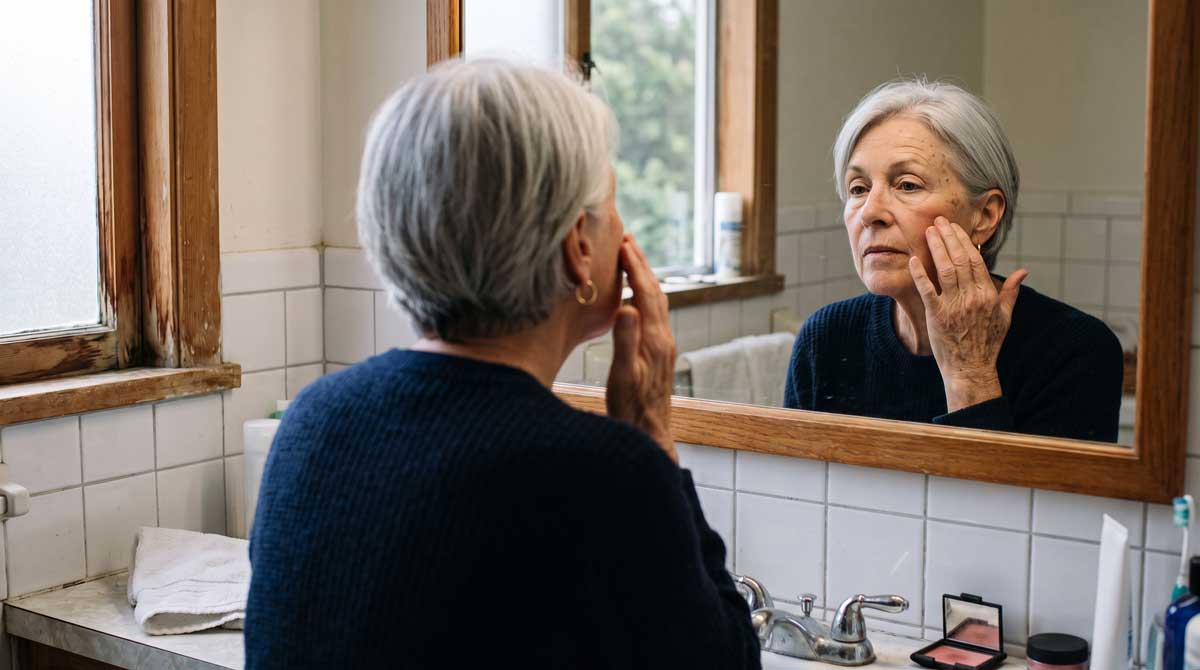
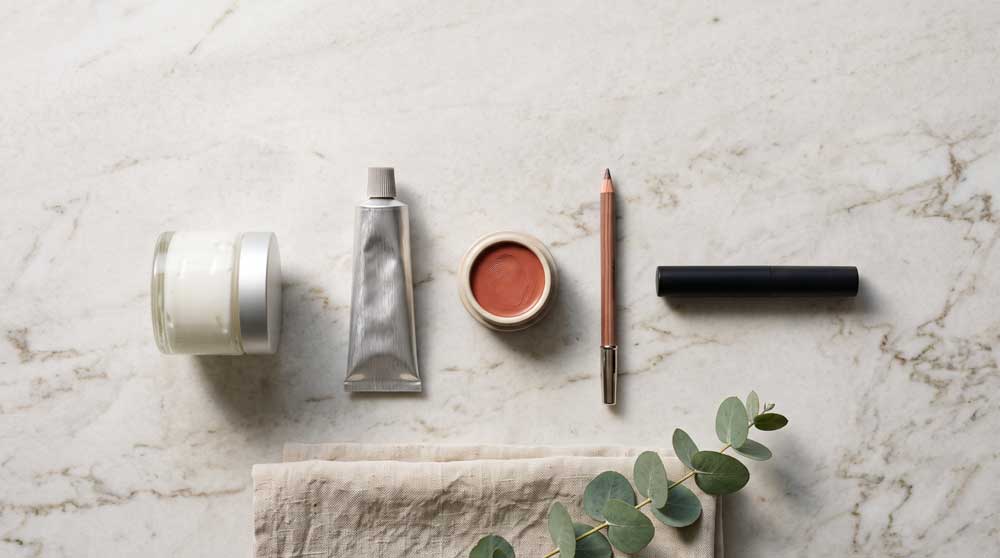
A simple makeup routine for mature skin takes about five minutes and five things: moisturizer, sunscreen, one cream color for cheeks and lips, a little definition on the brows, and one coat of mascara. That is the entire list. Everything else in the drawer is optional — and a fair amount of it is probably working against you.
Most of us learned to do our faces in the 1970s and 80s, when the goal was coverage. More foundation, more powder, set it, lock it down. That approach made sense on skin that produced plenty of its own oil. It makes considerably less sense now.
Skin changes. After 60, it produces less oil, holds water less easily, and has more texture for products to catch in. The routine that once looked polished can start to look like it is sitting on top of the face rather than part of it. The fix is almost always the same, and it is a relief: use less, and choose differently.
Key Takeaways
- Apply moisturizer within three minutes of washing or bathing — the American Academy of Dermatology recommends this for skin in your 60s and 70s, and makeup sits far better on hydrated skin.
- Use a broad-spectrum sunscreen with SPF 30 or higher every day you are outside, not just in summer and not just when it is sunny (American Academy of Dermatology).
- Cream blush and cream bronzer generally sit better than powders on skin that has more texture and less natural oil.
- Replace mascara every two to four months — manufacturers recommend it, and eye-area cosmetics carry the shortest safe shelf life of anything in the drawer (U.S. Food and Drug Administration).
- Good light does more for your application than a steady hand. After about age 40 the lens of the eye stiffens and close work simply requires more light (National Eye Institute).
Step One
Start With Skin, Not Products
The single biggest improvement most women see has nothing to do with makeup. It is moisturizer, applied at the right moment.
The American Academy of Dermatology advises applying a creamy, fragrance-free moisturizer within three minutes of bathing, while there is still a little water on the skin. That window matters — you are sealing moisture in rather than adding it back later. When skin feels very dry, dermatologists suggest an ointment instead of a cream.
The reason is straightforward. As the National Institute on Aging explains, the outer layer of skin thins with age and the glands produce less oil and sweat. Hormonal changes after menopause thin and dry it further. Nothing about that is a failure on your part; it is simply what skin does.
What it means practically: foundation applied to dry skin will find every flaky patch and settle into it. Foundation applied to well-moisturized skin has somewhere to sit. Give the moisturizer a minute or two to absorb before anything else goes on.
Step Two
Sunscreen Earns Its Spot — Even in the Fog
If you keep only one step from this list, keep this one.
The American Academy of Dermatology recommends a broad-spectrum, water-resistant sunscreen with SPF 30 or higher on all skin not covered by clothing, every day you are outside — not only during summer. “Broad spectrum” means it protects against both UVA and UVB rays; UVA is the one associated with collagen breakdown, discoloration, and the changes most of us think of as aging skin.
Those of us on the Peninsula and in the city have a particular blind spot here. A gray morning in Pacifica or the Sunset does not feel like a sun-exposure day. Overcast skies are not a sunscreen holiday, and the marine layer that burns off by eleven in San Mateo leaves plenty of afternoon behind it. Inland — Walnut Creek, San Jose, the Livermore Valley — the case makes itself.
Here is the part that saves you a step: a tinted mineral sunscreen can do the job of both sunscreen and light foundation. The AAD notes that tinted sunscreens are formulated to blend with a range of skin tones, and they also add protection against visible light. One product, one pass, two purposes. For a great many women over 60, a tinted SPF is all the base coverage the face actually needs.
Step Three
Trade Powder for Cream
This is the change women tell us made the most visible difference, and it costs nothing but a swap.
Powder blush and powder bronzer are designed to absorb oil and sit on a smooth surface. Skin that is drier and has more fine texture gives them neither. The result is color that looks dusty, or that gathers in the lines around the eyes and mouth instead of spreading evenly across the cheek.
Cream formulas behave differently. They melt into skin rather than resting on it, they move with the face, and they leave a finish that reads as skin rather than as product. Apply with clean fingertips — the warmth of your hands helps the product blend — and tap it on the apples of the cheeks, then blend outward and slightly up toward the temple. A small amount, well blended, beats a confident amount badly blended every time.
Two other small trades in the same spirit:
- Skip all-over foundation. Use concealer only where you actually want it — around the nose, under the eyes, on a spot of redness — and leave the rest of the face alone. Fewer products layered on means fewer edges to blend and less to settle into lines.
- Use the same cream color on lips. A cream blush doubles as a lip tint, which means one less product and a face that looks coordinated without effort. If lips are dry, a balm underneath gives it something to hold onto.
- Go easy on setting powder. Powder over cream products tends to undo the very thing that made them work. If shine genuinely bothers you, blot with a tissue mid-day instead.
Step Four
Two Minutes on Brows and Lashes
Brows and lashes both thin over time, and both frame everything else. This is where two minutes buys the most.
For brows, fill the sparse places with short strokes in a shade at or slightly lighter than your natural color, then brush through with a spoolie so nothing reads as a drawn line. The goal is a brow that looks like it grew there.
For lashes, one coat of mascara on the upper lashes is genuinely enough. Skip the lower lashes if smudging has become a problem — on skin that has softened under the eye, lower-lash mascara migrates, and the smudge is more noticeable than the lashes were.
One thing worth saying plainly, because it frustrates people who assume their hands are the problem: it is probably the light. The National Eye Institute explains that the lens inside the eye gradually stiffens with age and stops focusing light as precisely on the retina, which is why close work becomes harder and why brighter light helps so much. If you are doing your eyes in a dim bathroom, you are making a hard task harder. A lighted magnifying mirror, or simply moving to a window, will improve your results more than any technique will.
Step Five
Then Clean Out the Drawer
A simplified routine is easier to keep simple when the drawer is not full of products from another decade. This part is about safety as much as tidiness.
The U.S. Food and Drug Administration notes that eye-area cosmetics have a shorter safe shelf life than anything else, because the applicator is exposed to bacteria and fungi every single time it goes back in the tube. Manufacturers generally recommend discarding mascara two to four months after purchase. There is no U.S. law requiring expiration dates on cosmetics, so the date is yours to track — a permanent marker on the tube when you open it works perfectly well.
The FDA’s other eye-cosmetic guidance is worth keeping in mind:
- If mascara dries out, throw it away. Do not add water — and certainly not saliva — to loosen it, because that introduces bacteria directly into the product.
- Wash your hands before applying anything near the eye.
- Do not share eye makeup, and be cautious with store testers, which are more contaminated than the same product at home.
- If you develop an eye infection, stop using all eye-area cosmetics, speak with your doctor, and discard whatever you were using when it started.
- Do not apply mascara in a moving car — even as a passenger. A sudden stop and a wand at the eye can scratch the cornea, and a small scratch can become a serious infection.
If any product smells different, has changed color, or has separated, let it go. And if you find yourself reaching for the same five things every morning anyway, that is your answer about the rest of it.
The Routine
The Five-Minute Face, Start to Finish
Here it is in order, for a morning when you are not thinking about any of the above:
- Moisturize within three minutes of washing. Let it settle for a minute.
- Tinted sunscreen — broad-spectrum SPF 30 or higher — over the whole face, applied with fingertips.
- Concealer only where you want it. Tap, do not rub.
- Cream blush on the cheeks, blended out and up. Same product on the lips.
- Brows and one coat of mascara, in good light.
That is the whole routine. It travels well, it works for a morning walk at Sawyer Camp Trail and for dinner in Los Gatos, and it does not require you to relearn anything on a bad day.
None of this is about looking younger. It is about the face in the mirror looking like you on a good day — rested, defined, comfortable — without twenty minutes and eleven products standing between you and the door. Most women who make this switch report the same thing: fewer products, less fuss, and a result they actually prefer.
Start with the moisturizer and the sunscreen. Those two are the foundation of everything else, and they are the two that keep paying you back long after the makeup comes off.
Bay Area Skin Health Resources
Makeup sits on top of skin health, not in place of it. If something on your face has changed — a spot that is new, itches, bleeds, or looks different from the others — that is a dermatologist question, not a concealer question.
- Free skin cancer checks — The American Academy of Dermatology has run a free screening program since 1985 and maintains a locator for upcoming checks near you. Find a free skin cancer check.
- Medicare and dermatology — Medicare Part B covers medically necessary dermatology services, including biopsies and treatment of suspicious growths, subject to the Part B deductible and 20% coinsurance. Routine screenings without signs of skin cancer, and anything cosmetic, are generally not covered. AARP’s overview of Medicare dermatology coverage explains the distinction.
- Your county’s Area Agency on Aging — For health counseling, wellness programs, and senior center services in San Mateo, Santa Clara, Alameda, Contra Costa, or Marin County, the California Department of Aging maintains a county-by-county directory. Find services in your county, or call the statewide line at 800-510-2020.
Frequently Asked Questions
What is the simplest makeup routine for mature skin?
A simple makeup routine for mature skin has five steps: moisturizer applied within three minutes of washing, a broad-spectrum tinted sunscreen of SPF 30 or higher, concealer only where needed, a cream blush used on both cheeks and lips, and brows plus one coat of mascara. The whole routine takes about five minutes and uses five products.
Should women over 60 use cream or powder blush?
Cream blush generally works better on mature skin. Powder formulas are designed to absorb oil and sit on a smooth surface, so on skin that produces less oil and has more fine texture, they tend to look dusty or settle into lines. Cream formulas blend into the skin, move naturally with the face, and can double as a lip color.
How often should I replace my mascara?
Manufacturers generally recommend discarding mascara two to four months after purchase, according to the U.S. Food and Drug Administration. Eye-area cosmetics have the shortest safe shelf life of any cosmetic because the wand is exposed to bacteria and fungi with every use. U.S. law does not require expiration dates on cosmetics, so write the date you opened it on the tube.
Do I need sunscreen in the Bay Area if it is foggy?
Yes. The American Academy of Dermatology recommends applying broad-spectrum sunscreen with SPF 30 or higher to all skin not covered by clothing every day you are outside, not just during summer. Overcast and foggy conditions do not eliminate ultraviolet exposure, and Bay Area mornings that start gray frequently turn sunny by midday.
Why is it harder to apply eye makeup than it used to be?
It is usually the light, not your hands. The National Eye Institute explains that the lens inside the eye stiffens with age and no longer focuses light as precisely on the retina, which makes close-up work harder and increases the amount of light you need. A lighted magnifying mirror or a spot by a window improves results more than any change in technique.
Do I still need foundation if I wear tinted sunscreen?
Often not. A tinted mineral sunscreen provides light, even coverage while also delivering broad-spectrum protection, which for many women over 60 is all the base the face needs. Adding concealer only where you want it — around the nose, under the eyes, on a spot of redness — usually covers the rest.
Sources
- American Academy of Dermatology — How to care for your skin in your 60s and 70s, accessed September 2026
- National Institute on Aging — Skin Care and Aging, accessed September 2026
- American Academy of Dermatology — Sunscreen FAQs, accessed September 2026
- American Academy of Dermatology — How to select a sunscreen, accessed September 2026
- American Academy of Dermatology — The latest in sun protection (tinted sunscreens), accessed September 2026
- U.S. Food and Drug Administration — Eye Cosmetic Safety, accessed September 2026
- U.S. Food and Drug Administration — Shelf Life and Expiration Dating of Cosmetics, accessed September 2026
- National Eye Institute — Presbyopia, accessed September 2026
- American Academy of Dermatology — Free skin cancer checks, accessed September 2026
- AARP — What Dermatology Services Are Covered by Medicare?, July 21, 2023
- California Department of Aging — Find Services in My County, accessed September 2026

